
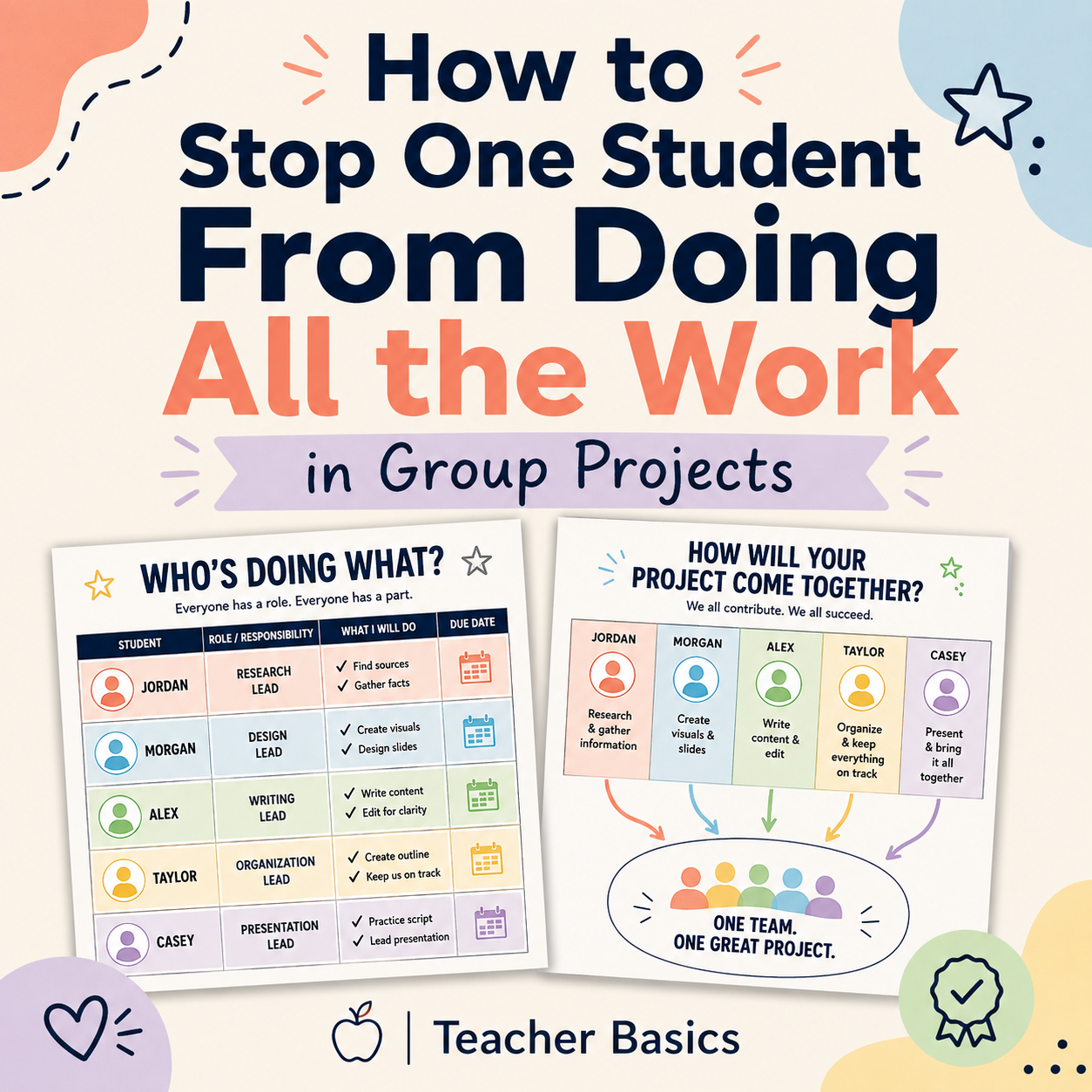

You assign a group project.
One student immediately takes charge.
Another student does a little research.
Someone says, “Just tell me what you want me to do.”
And somehow, two days before the project is due, one student is doing almost everything.
Sound familiar?
For years, I tried different ways to organize group work. What finally worked for me was not giving students more group roles.
It was making individual responsibility visible before the project ever started.
The Problem With “Everyone Work Together”
“Work together” sounds great until students actually have to decide what that means.
If the work has not been divided clearly, students often fall into predictable patterns. One student takes over. Another waits to be told what to do. Someone assumes another group member is completing a section. And when something is missing, suddenly no one knows who was responsible for it.
The issue is not always effort.
Sometimes the problem is simply that ownership was never clear.
Before my students started a group project, I wanted them to be able to answer one question:
Who’s doing what?
Not eventually.
Not halfway through the project.
Before they started working.
Break the Project Into Actual Work
I do not automatically assign students generic jobs such as leader, recorder, researcher, or timekeeper.
Sometimes those roles make sense. Often they do not.
Instead, I look at the actual project and break it into the pieces students need to complete.
That might mean dividing:
- research topics
- questions
- sections of a presentation
- parts of a lab
- website pages
- data analysis
- graphs
- written sections
- models
- content students need to explain
Then each part belongs to someone.
For example, in a cell project I used with my biology students, each student was responsible for a specific group of organelles.
One student might be responsible for the cell wall, vacuole, cytoplasm, and cell membrane.
Another student might own the nucleolus, attached ribosomes, rough ER, and Golgi apparatus.
The students were still creating one group project, but there was never any confusion about who was responsible for each piece.
That is very different from telling four students to “research cell organelles together.”
Be Specific About the Responsibility
This is one of the most important parts.
Do not write: Research
Instead:Research the causes of the event and identify two reliable sources.
Do not write: Make slides
Instead: Create slides 3–5 using your assigned research and include at least two visuals.
Do not write: Graph
Instead: Create the graph using the group data and write a short explanation of the pattern shown.
The clearer the responsibility is at the beginning, the easier it becomes for students to work independently.
It also becomes much easier for the group to see when something has not been completed.
Connect Individual Work to the Big Picture
Assigning individual work is only half of the system.
Students also need to understand where their work belongs in the final project.
This is where I use color coding.
Each group member is assigned a color.
That color follows the student from their individual responsibilities to their section of the final project.
So if the blue student owns four specific tasks on the Who’s Doing What? page, the blue section on the final project planner shows exactly where those tasks will be used.
Students can visually see:
This is what I am responsible for.
and
This is where my work fits into our final product.
That simple connection makes the group project much easier to understand.
Sometimes I Start With the Work
For some projects, I already know exactly how I want the assignment divided.
I identify the required work first, assign the pieces to students, and then have the group determine how those pieces will come together in the final product.
The process looks like this:
Break up the work → assign ownership → build the final product
This works especially well when the project contains several clearly defined topics, questions, lab components, or research areas.
Sometimes I Start With the Big Picture
Other times, I work in the opposite direction.
The group first decides what the final product will look like.
Maybe they are creating a website with four tabs.
Maybe they are creating a presentation with different sections.
Maybe they are building a model and explaining different components.
Once the big picture is clear, students divide those sections among group members and identify the individual tasks required to complete each one.
That process looks like:
Plan the final product → divide the sections → assign the work
Both approaches accomplish the same thing.
Every student knows what they own.
Let Students Adjust When It Makes Sense
I often gave students a suggested way to divide the work, but that did not mean the plan could never change.
If a group found a better way to divide responsibilities, they could adjust it.
The expectation was simple:
All required work must still be covered, and everyone must have a meaningful responsibility.
If responsibilities changed, the group updated the plan.
The important part was keeping ownership visible.
Be Careful With Large Groups
More students do not automatically make a project easier.
If there are five students but only three meaningful pieces of work, somebody is probably going to end up with a made-up job or very little responsibility.
Before creating a large group, ask:
Is there enough meaningful work for every student to own something?
If the answer is no, use a smaller group.
The goal is not to fill seats.
The goal is to create clear responsibility.
The System Should Reduce Teacher Work Too
I do not want a classroom system that creates another tracking sheet for the teacher.
Students should be able to look at the group plan and know:
What am I doing?
What does my partner own?
What still needs to be completed?
Where does my work go in the final product?
If students can answer those questions without asking the teacher, the system is doing its job.
And when something is missing, you no longer have to ask the entire group:
“Who was supposed to do this?”
It is already visible.
Group Work Does Not Have to Mean Group Confusion
Group projects can teach collaboration, communication, problem solving, and responsibility.
But students need structure.
For me, that structure was never about assigning everyone a cute job title.
It was about making the work visible.
Break the work into clear responsibilities.
Assign ownership.
Connect each person’s work to the final product.
Make it visible.
That is the idea behind my Who’s Doing What? Group Project Accountability & Planning System. It includes color-coded templates for groups of 3, 4, and 5 students, teacher implementation guidance, and a completed classroom example so teachers can adapt the system to their own projects.
Ready to make group responsibilities visible before the project even begins? [Get the Who’s Doing What? Group Project Accountability & Planning System on Teachers Pay Teachers.]
Because sometimes the best classroom management question is also the simplest:
Leave a Reply