

A new student can walk into your classroom in October, January, or March and suddenly you are expected to teach them everything your original students learned during the first weeks of school.
Where do they sit?
Where do they get handouts?
Where is bell work?
How does Google Classroom work?
Where do they turn things in?
What happens if they are absent?
Who do they ask when they are confused?
If you stop class and explain every routine one at a time, you lose instruction. If you do not explain enough, the student spends the next several weeks asking questions because they never learned how your classroom works.
The solution is not another welcome packet.
It is a new-student onboarding system.
Start With the Systems You Already Have
The first thing I would not do is create an entirely separate set of materials just for transfer students.
Use what you already created for the beginning of the year.
Your syllabus, classroom procedures, hall-pass system, late-work information, parent forms, digital classroom instructions, and first-week activities can all become part of your new-student onboarding.
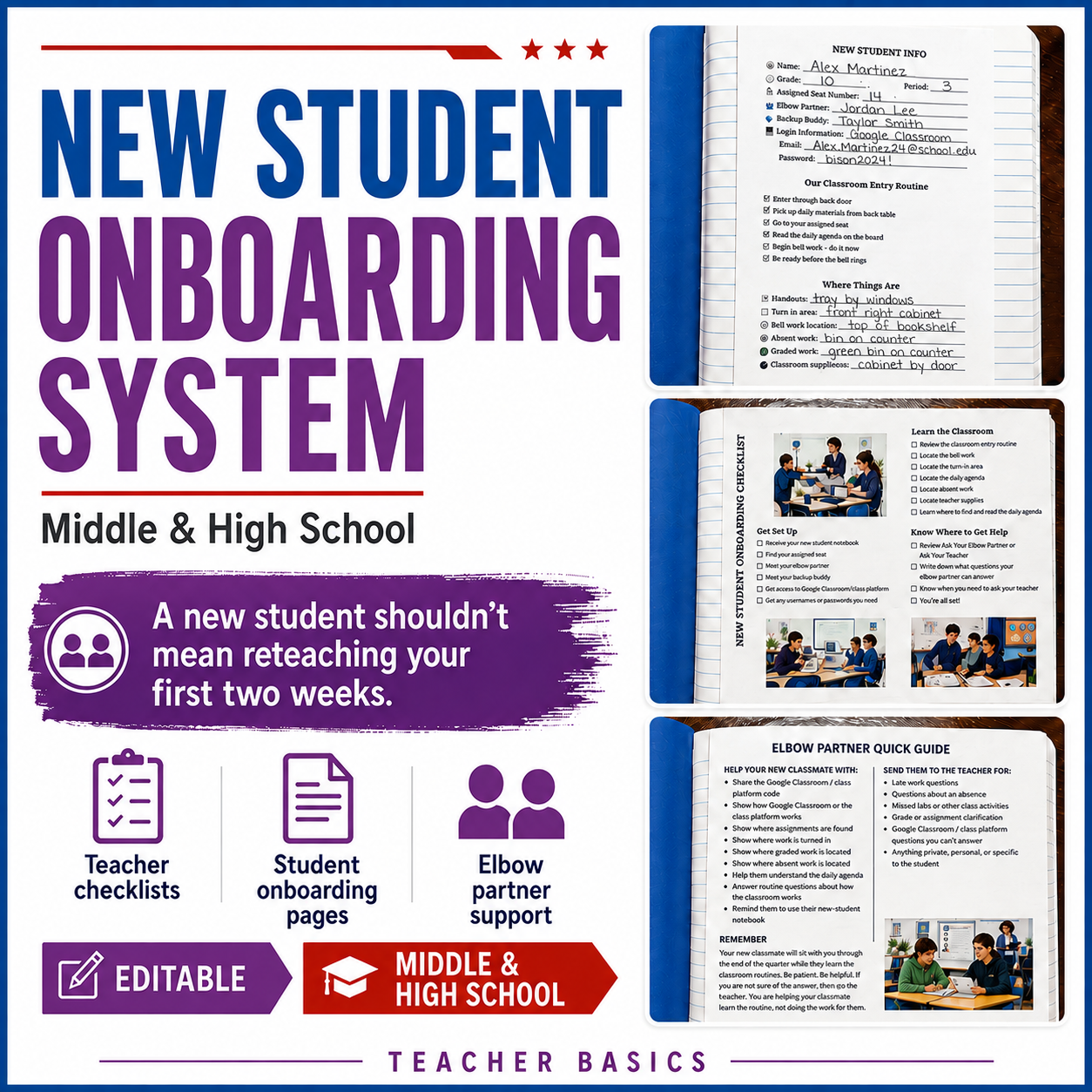
Once your beginning-of-year rosters settle, prepare several identical notebooks or folders using those same materials.
Then when a new student arrives, you are not rebuilding anything.
You grab a notebook and begin.
Personally Teach the Non-Negotiables
There are some routines I would never leave completely to another student.
The most important one is the classroom entry routine.
A new student needs to know:
- where to enter;
- where daily handouts are located;
- where to find bell work or the opening task;
- where their assigned seat is;
- where to find and read the daily agenda;
- and what should be happening before the bell rings.
These few routines are the foundation of a self-managed classroom.
If students know what to do the moment they walk through the door, you eliminate a large number of repeated questions and interruptions.
This part deserves a few minutes of direct teacher instruction.
The rest can be supported in other ways.
Choose a Reliable Elbow Partner
A new student does not need to ask the teacher every routine question.
Seat the student beside someone who already knows how the classroom works.
Choose an elbow partner who is:
- reliable;
- present regularly;
- patient;
- kind;
- helpful;
- a strong student;
- and familiar with your classroom systems.
The new student can remain seated beside that person through the end of the quarter.
The elbow partner can help with things like:
- basic Google Classroom navigation;
- finding assignments;
- locating classroom supplies;
- finding the turn-in area;
- locating graded and absent work;
- reading the daily agenda;
- and answering routine questions about how the classroom operates.
A backup buddy is also useful in case the primary elbow partner is absent.
The elbow partner is not the teacher.
They are simply a reliable classroom support person.
Teach Students Who to Ask
One of the easiest ways to reduce repeated questions is to make it clear which questions can go to the elbow partner and which need to come directly to the teacher.
Routine classroom questions can usually go to the elbow partner.
Teacher-level questions should still come to the teacher.
That includes:
- late work;
- absences;
- missed tests or quizzes;
- missed labs or activities;
- grades;
- assignment or lesson clarification;
- Google Classroom questions that go beyond basic navigation;
- and anything personal or private.
This distinction matters.
You want the student to become independent, but you do not want another student making decisions that belong to the teacher.
Let the Rest of the Onboarding Happen Independently
Everything does not need to happen on Day 1.
Once the student understands the critical classroom routines and knows who can help them, the rest of the onboarding can happen gradually.
In a digital classroom, keep a First Week of School or New Student section available in Google Classroom or your LMS.
That section can include:
- classroom procedures;
- digital platform instructions;
- syllabus review;
- course expectations;
- required beginning-of-year activities;
- and any other information a new student still needs.
If you use paper materials, place the same information in the new-student notebook.
Students can complete the remaining onboarding during:
- leftover class time;
- the last few minutes of class;
- or at home.
The important part is that the process no longer depends on you stopping instruction every time a new student enrolls.
Do a Visual Check Instead of Creating More Paperwork
You do not need another complicated tracking system.
Watch the student.
Can they enter the room correctly?
Can they find the materials they need?
Do they read the agenda?
Can they access classwork?
Do they know where to turn things in?
Do they know when to ask their elbow partner and when to ask you?
If not, redirect.
That is usually enough.
The goal is not to perfectly recreate the first weeks of school.
The goal is to give the new student enough structure and support to begin functioning inside the classroom systems that are already running.
Prepare Once. Reuse All Year.
A new student should not mean rebuilding your classroom routines from scratch.
Prepare the materials once.
Teach the critical routines yourself.
Give the student a reliable support person.
Let the rest of the onboarding happen gradually.
Redirect as needed.
That is the system.
If you want the editable checklists, elbow partner guides, student reference pages, notebook setup tools, and digital/paper onboarding framework, the New Student Onboarding System for Middle & High School brings the entire process together in one ready-to-use resource.
Questions? Please feel free to reach out if you have questions about the system, setup, or how to adapt it to your classroom. I’m happy to help you figure out how to make it work with the routines and platforms you already use.
Leave a Reply