

Late work is one of those classroom management issues that sounds simple until you are actually dealing with it every day.
Do you accept it? How late is too late? Do you take points off? What happens when a student turns in six assignments during the last week of the quarter?
For me, the answer became a system that gave students a second chance without creating an unlimited late-work policy.
The Problem Started With Freshmen
When I taught freshmen, many of my students came from middle school without much experience managing regular homework deadlines.
The transition to high school could be rough.
Suddenly, assignments had firm due dates. Homework mattered. Missing a deadline had consequences.
I did not want students learning that lesson by immediately piling up zeros during their first few weeks of high school. At the same time, I did not want to spend the entire quarter collecting assignments whenever students finally decided to complete them.
So I started using Late Work Passes.
Three Second Chances
My original system was simple.
Each student received three Late Work Passes per quarter.
If an assignment was due Monday and the student brought it Tuesday, it was late. To turn it in, the student needed to use a pass.
The pass allowed the assignment to be submitted without a late penalty and remain eligible for full credit.
But there was still a deadline.
Students had one week from the original due date to submit the assignment. After that, I did not take it, even if they still had a pass available.
Once all three passes were gone, they were gone until the next quarter.
There was no endless pile of late work waiting for me at the end of the grading period.
The Pass Wasn’t the Most Important Part
The part of this system I liked most was actually the decision-making.
A Late Work Pass had value.
Students could use one on a 20-point homework assignment. They could also save it and later need it for a 50-point lab report or a 100-point project.
That meant I had to teach them how to think about their passes.
Especially with freshmen, I would build scenarios into bell work or class discussions.
For example:
A 20-point homework assignment was due yesterday. You have one Late Work Pass left. Next week you have a 50-point lab report due. Do you use the pass now or save it? Why?
There was not always one perfect answer.
The point was to get students thinking about deadlines, priorities, and consequences before making the decision.
I Also Gave Them a Reason to Save a Pass
Unused passes were worth 10 extra-credit points each at the end of the quarter.
If a student finished the quarter without using any of the three passes, that could mean 30 extra-credit points.
But I also taught them not to blindly save every pass for extra credit.
Taking a zero on a 100-point project just to save a pass worth 10 points does not make much sense.
Again, they had to make the decision.
That was the part I wanted.
Keeping the Pass Was Part of the Responsibility
I tried the passes a few different ways over the years.
At one point, students cut out individual passes and attached them to their late assignments.
That worked, but loose passes disappeared.
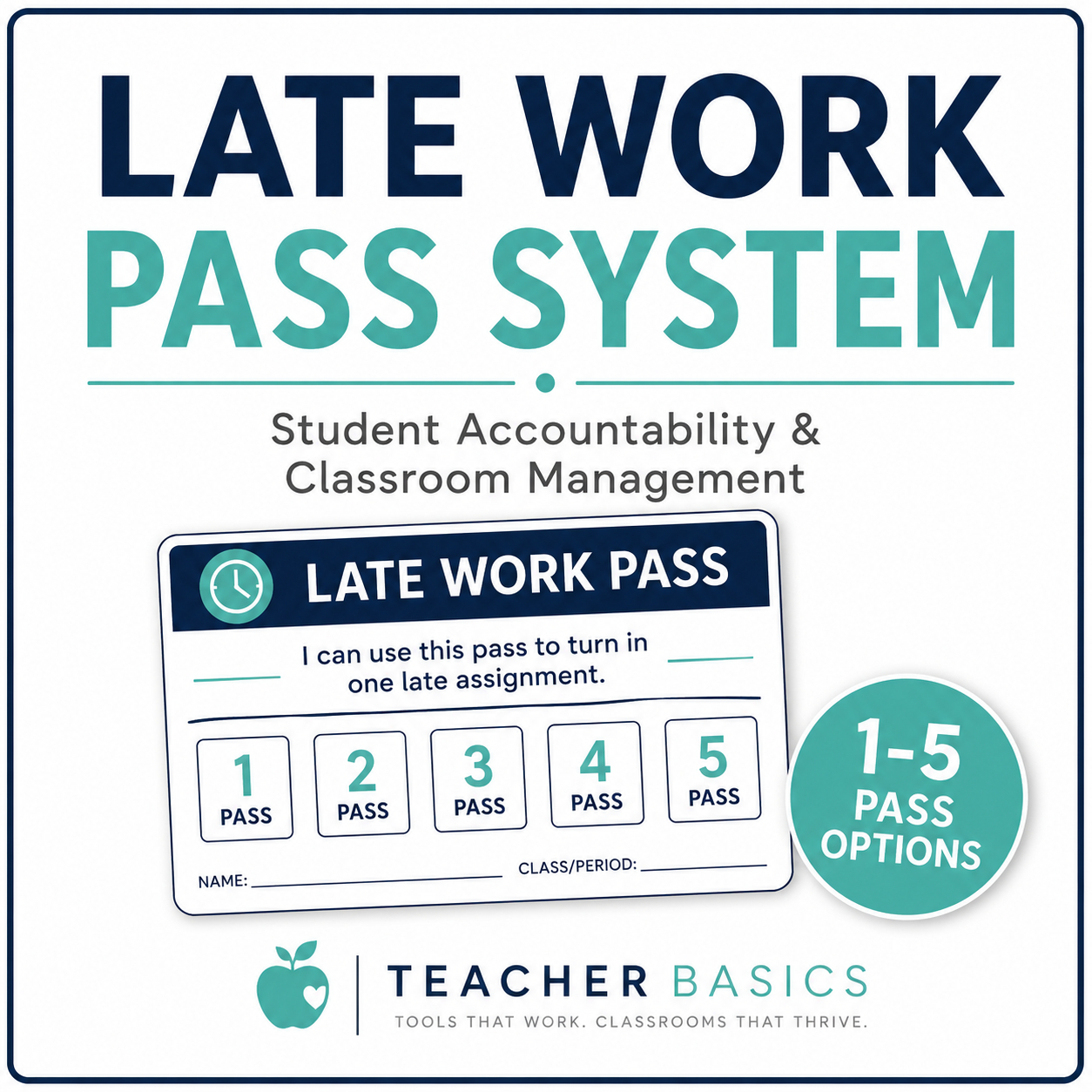
Eventually, I moved to one card with three numbered pass boxes. Students taped it inside the front cover of their notebook or binder.
When a student used a pass, I dated and initialed the next available box.
Simple.
I also recorded that each student had received the card at the beginning of the quarter.
If the card was lost, I did not replace it.
That may sound strict, but keeping track of the pass was part of the system. Students were learning to manage something that had value to them.
Excused Absences Were Different
A Late Work Pass was not meant to penalize students for being legitimately absent.
Work missed because of an excused absence followed my normal absent-work procedures.
The pass was specifically for the everyday missed deadline.
Forgot the assignment at home.
Did not finish it.
Lost track of the due date.
Those are the situations where the student had to decide whether the assignment was worth using one of their limited passes.
I Didn’t Introduce It on Day One
The first week of school was already full.
I spent that time teaching the procedures that students needed immediately: how to enter the room, where to pick up papers, where to turn things in, assigned seating, bell work, and the basic rituals and routines that made the classroom function.
Homework was usually light during that first week anyway.
I typically introduced the Late Work Pass System during Week 2, when we went over the syllabus and homework was about to become more regular.
By then, students were beginning to understand how the classroom worked and were ready for another layer of responsibility.
The Goal Was Never to Be Harsh About Late Work
The goal was structure.
I did not want unlimited late work.
I also did not want one forgotten assignment to destroy a student’s grade.
The passes created a middle ground.
Students had second chances, but those chances were limited.
They could recover from a mistake, but they also had to think about when that second chance was worth using.
And I was no longer making a new late-work decision every time a student walked up to me with an overdue paper.
The system had already answered the question.
Want to Use the System in Your Classroom?

I turned this classroom routine into the Late Work Pass System, including 1-, 2-, 3-, 4-, and 5-pass options, teacher implementation guidance, and Use It or Save It? scenarios to help students practice making smart decisions about their passes.
The number of passes, extra-credit incentive, and other details can be adjusted to fit your classroom.
Because the exact numbers are not really the point.
The system is.
Limited second chances. Clear expectations. Student responsibility.
Leave a Reply